


⚡ Key Takeaways
- Diet and exercise ask you to override your biology. Medical weight loss addresses the biology itself.
- Your body defends a biological set point — when you lose weight, it fights to bring it back.
- Weight loss triggers measurable hormonal changes: ghrelin (hunger) rises, leptin (fullness) falls, metabolism slows.
- Regain after dieting is physiology, not a character flaw — and it can persist for years.
- Medical weight loss works alongside diet and exercise, not instead of them — it makes those efforts effective.
Medical weight loss vs diet and exercise isn’t a debate about which one is “better” — it’s a question about what’s actually happening inside your body when you try to lose weight. And the answer explains something millions of people have been made to feel ashamed about for decades.
You’ve done it before. You cut the calories. You showed up to the gym. You tracked everything, said no to the things you wanted, and for a while it worked — the scale moved and you felt hopeful. Then it stalled. Then, slowly, it came back. And somewhere in that process, a quiet voice told you the same thing everyone else does: you just didn’t want it badly enough.
Here’s the truth that voice has wrong: the reason diets fail isn’t a lack of willpower. It’s biology. Your body has powerful, measurable systems designed to defend your weight — and when you lose weight, those systems turn on and fight back. In this guide, we explain exactly what happens biologically when you diet, why that makes long-term weight loss so difficult through effort alone, and how medical weight loss works differently by addressing the physiology that willpower simply cannot outmuscle.
Medical Weight Loss vs Diet & Exercise: The Core Difference
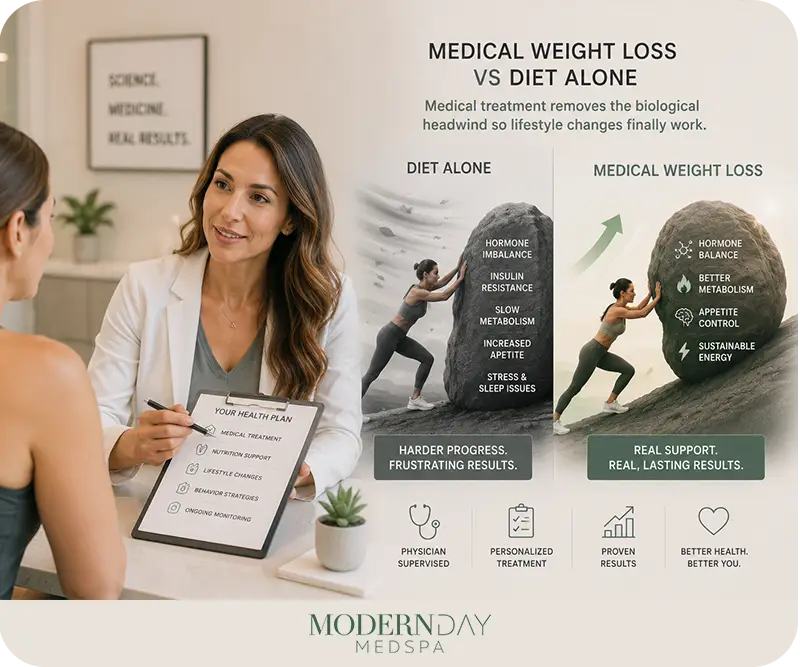
The fundamental medical weight loss vs diet and exercise difference comes down to this: diet and exercise ask you to override your biology through behavior and willpower. Medical weight loss addresses the biology itself. Medical weight loss doesn’t replace healthy eating and movement — it includes them. What it adds is medically supervised treatment that influences the hunger hormones, metabolic adaptation, and set point mechanisms that behavioral change alone cannot reach.
💪
Diet & Exercise Alone
Override biology with behavior
VS
🩺
Medical Weight Loss
Address the biology directly
This isn’t a criticism of diet and exercise. They matter enormously — they always will. The problem is that for many people, they’re being asked to do something they were never capable of doing alone: overpowering a biological system that is actively, aggressively working against them.
“The hunger you feel when dieting isn’t an indication that you’re lacking in willpower. It’s a hormonal change that makes it very difficult for you to stick to your diet in the long term.”
— Marcio Griebeler, MD, endocrinologist and obesity specialist, Cleveland Clinic
Why Your Body Fights Weight Loss: Set Point Theory
Set point theory describes how your body works to maintain a specific “target” weight — whether or not that weight is healthy for you. Determined by the interaction of your genetics, biology, and environment and regulated closely by your brain, your set point acts like a thermostat. When your weight drops below what your body considers normal, powerful biological defenses activate to bring it back.
From an evolutionary standpoint, this made perfect sense. For most of human history, losing weight meant famine, and a body that fought to preserve fat stores kept you alive. Your biology hasn’t updated for a world of abundant food — it still treats a calorie deficit as a survival threat and responds accordingly.
Here’s what makes this so cruel in practice: the harder and faster you diet, the more aggressively your body defends itself. This is the biological explanation for the plateau nearly every dieter knows — initial success, followed by stagnation, followed by regain, even while continuing to do everything “right.”
4 Biological Forces Working Against Your Diet
Understanding the medical weight loss vs diet question requires knowing exactly what your body does when you lose weight. These aren’t feelings or excuses — they’re measurable physiological changes.
1. Ghrelin Rises — You Get Hungrier
Ghrelin is your body’s hunger hormone. When you lose weight, ghrelin levels increase — signaling your brain to eat more, and to think about food more often. This is why people who’ve lost weight frequently describe feeling hungrier than before they started. It isn’t imagined, and it isn’t weakness. It’s a measurable hormonal response designed to drive you back toward your set point.
2. Leptin Falls — You Feel Less Full
Leptin is the hormone that tells your brain you’ve had enough. As you lose fat, leptin production drops, meaning the “stop eating” signal gets quieter exactly when you need it most. In people with obesity, leptin signaling can also become less effective over time. So you’re hungrier and less easily satisfied — a brutal combination for anyone relying on discipline alone.
3. Metabolism Slows — You Burn Fewer Calories
Your body reduces its total energy expenditure, burning fewer calories at rest and during activity. This metabolic adaptation means the same diet and workout routine that produced results in month one produces less in month four. Crucially, this slowdown can persist for years after dieting — which is why so many people find each successive attempt harder than the last.
4. Underlying Conditions Add Resistance
For many people, additional factors stack the deck further: insulin resistance, thyroid dysfunction, hormonal imbalance, chronic stress elevating cortisol, poor sleep, and certain medications can all make weight loss substantially harder. When these go unidentified, no amount of dietary effort will fully correct them — because the effort isn’t addressing the actual problem.
↑
Ghrelin (hunger hormone) rises after weight loss
↓
Leptin (fullness hormone) falls after weight loss
Years
How long metabolic slowdown can persist after dieting
Franklin Park IL · Medical Weight Loss
Tired of Fighting Your Own Biology?
Book a medical weight loss consultation at Modern Day Med Spa in Franklin Park IL. Our team will evaluate what's actually driving your weight and build a plan around your physiology, not just your willpower.
How Medical Weight Loss Works Differently
If diet and exercise alone ask you to out-discipline your biology, medical weight loss takes a different approach: it changes the conditions you’re fighting under. Here’s how:
🩺 What Medical Weight Loss Actually Does
- Quiets the hunger signal: GLP-1 medications work with your body’s natural appetite-regulating hormones, reducing hunger and food preoccupation rather than asking you to endure them.
- Restores fullness: By slowing gastric emptying and enhancing satiety signaling, these treatments help you feel satisfied with less — making a calorie deficit sustainable instead of a daily battle.
- Identifies hidden barriers: Medical evaluation uncovers thyroid dysfunction, hormonal imbalance, insulin resistance, and other factors that sabotage effort silently.
- Provides medical oversight: A licensed provider monitors your progress, manages side effects, and adjusts your plan — you’re not doing this alone or guessing.
- Makes lifestyle change effective: Nutrition and exercise still matter enormously. Medical treatment doesn’t replace them — it removes the biological headwind so your efforts finally produce results.
Medical Weight Loss vs Diet & Exercise: Side-by-Side
| FACTOR | DIET & EXERCISE ALONE | MEDICAL WEIGHT LOSS |
|---|---|---|
|
Approach |
Override biology with behavior |
Address biology directly |
|
Hunger hormones |
Endure them |
Treatment influences them |
|
Metabolic adaptation |
Unaddressed |
Accounted for medically |
|
Hidden conditions |
Often undetected |
Identified through evaluation |
|
Supervision |
On your own |
Provider-monitored |
|
Diet & exercise needed? |
Yes |
Yes — still essential |
|
Best for |
Those whose biology cooperates |
Those whose biology resists |
According to the Cleveland Clinic, obesity is a disease and a physiologic dysfunction — and your body will work in a variety of ways to defend itself and keep you from losing weight. Understanding this reframes the entire conversation: treating it medically isn’t taking a shortcut, it’s treating a medical condition appropriately.
Is Medical Weight Loss “the Easy Way Out”?
This deserves a direct answer: no. And the question itself reveals how deeply the willpower myth has taken hold.
Nobody accuses a person with high blood pressure of taking the easy way out for treating it medically. Nobody suggests someone with hypothyroidism should just try harder. Yet weight — uniquely among medical conditions — gets treated as a referendum on character. It isn’t one.
Medical weight loss doesn’t remove the need for effort. Patients still change how they eat. They still move their bodies. They still build habits and show up consistently. What changes is that their effort finally works, because it’s no longer being canceled out by biological forces they can’t see and couldn’t control.
⚠️ Important medical note: Medical weight loss treatments are prescription medications requiring evaluation, prescription, and ongoing monitoring by a licensed medical provider. They are not appropriate for everyone and carry potential side effects and contraindications. This article is educational and is not medical advice. A consultation determines whether medical weight loss is right for your health and goals.
Who Is Medical Weight Loss For?
The medical weight loss vs diet question isn’t about choosing a side — it’s about matching the approach to your situation. Medical weight loss may be worth exploring if:
- You’ve dieted successfully before — and regained it. Repeated cycles of loss and regain are the clearest signature of biological defense at work.
- You’re doing everything right with little result. Consistent effort producing minimal change suggests something beyond behavior is involved.
- You feel constantly hungry when dieting. That’s your hormones, not your character.
- You suspect an underlying condition. Thyroid, hormonal, or metabolic issues may be silently working against you.
- You want medical guidance, not another program. Personalized, supervised care rather than a generic plan.
Curious how the two leading medical weight loss medications compare? Read our guide to semaglutide vs tirzepatide weight loss →
📚 Related Reading from Modern Day Med Spa
- Semaglutide vs Tirzepatide Weight Loss: Which GLP-1 Is Right for You?
- Thyroid Weight Loss: 7 Ways an Underactive Thyroid Holds You Back
- Book Your Weight Loss Consultation
Medical Weight Loss vs Diet — Frequently Asked Questions
What is the difference between medical weight loss and diet and exercise?
Diet and exercise ask you to override your biology through behavior and willpower. Medical weight loss addresses the biology itself — using medically supervised treatment to influence the hunger hormones, metabolic adaptation, and set point mechanisms that cause weight regain. Medical weight loss includes diet and exercise, but adds medical tools that behavioral change alone cannot replicate.
Why is losing weight with diet and exercise so hard?
When you lose weight, your body defends its set point by increasing ghrelin (the hunger hormone), decreasing leptin (the fullness hormone), and slowing your metabolism. This creates a measurable biological state of increased hunger and reduced fullness that drives weight regain — regardless of discipline. It is physiology, not a character flaw.
Does medical weight loss mean you don't need diet and exercise?
No. Medical weight loss is not a replacement for healthy eating and physical activity — it works alongside them. Medical treatment makes lifestyle changes achievable and sustainable by quieting the biological forces that fight against them, but nutrition, movement, and consistent habits remain essential to long-term results.
Is medical weight loss a shortcut or the easy way out?
No. Medical weight loss is a legitimate medical treatment for a physiological condition, prescribed and monitored by a licensed provider. It does not remove the need for effort — it makes that effort effective by addressing biological barriers. Treating obesity medically is no more a shortcut than treating high blood pressure or any other medical condition.
Why do I gain the weight back after every diet?
Weight regain after dieting is driven by biology, not failure. Your body defends its set point through increased hunger hormones, reduced fullness signaling, and a slowed metabolism that can persist for years after weight loss. These forces make regain the default outcome for many people — which is precisely the problem medical weight loss is designed to address.
Is medical weight loss right for everyone?
No. Medical weight loss involves prescription treatments that require medical evaluation and are not appropriate for everyone. Factors like your health history, current conditions, medications, and goals all determine whether it’s suitable. A consultation with a licensed provider is the only way to know whether it’s the right approach for you.
Medical Weight Loss vs Diet: It Was Never About Willpower
If you’ve spent years believing your weight was a measure of your discipline, here’s what the science actually says: it wasn’t. Your body has powerful, measurable biological systems designed to defend its set point — raising hunger, lowering fullness, and slowing metabolism the moment you start losing weight. Those forces don’t care how badly you want it. They’re not negotiable through effort alone.
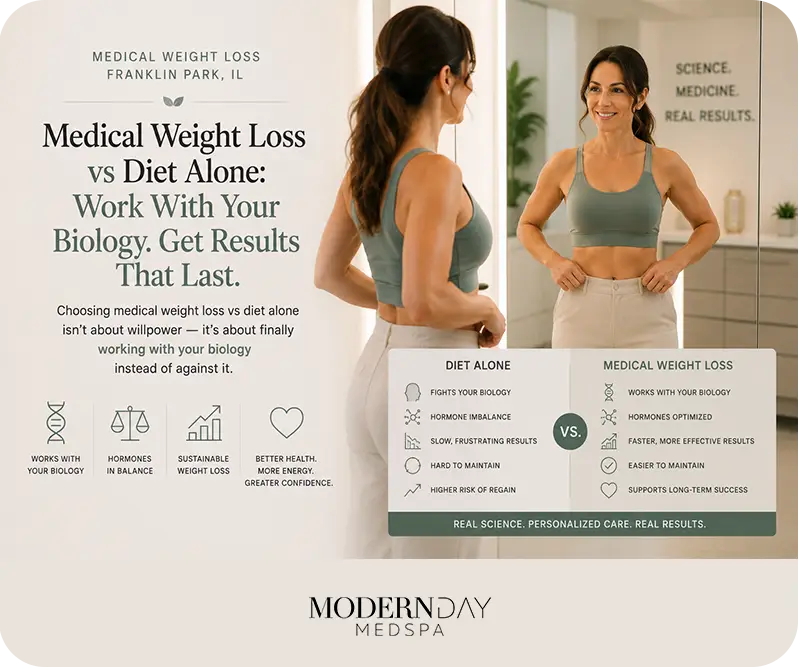
That’s the real answer to the medical weight loss vs diet and exercise question. It’s not that one works and the other doesn’t. It’s that diet and exercise ask you to win a fight against your own physiology — while medical weight loss changes the terms of that fight. You still do the work. It just finally counts for something.
At Modern Day Med Spa in Franklin Park IL, medical weight loss begins with understanding what’s actually happening in your body — through a real conversation and proper evaluation. Not another program. Not another round of trying harder. If you’re tired of fighting your own biology, the first step is simply finding out what you’re up against.
Stop Fighting Your Biology. Start Working With It.
Book a medical weight loss consultation at Modern Day Med Spa in Franklin Park IL. Our team will evaluate what's really driving your weight and build a personalized, medically supervised plan around your body — not just your willpower.